Saturday, January 11, 2014
The Mirror of Literature, Amusement, and Instruction 1832
The Elephants in the Zoological Gardens, Regent's Park
The annexed Engraving will probably afford the reader a better idea of the Zoological Gardens, than did either of our previous Illustrations. It is indeed a fair specimen of the luxurious accommodation afforded by the Society for their animals; while it enables us to watch the habits of the stupendous tenants in a state of nature, or at least, free from unnecessary restriction or confinement. It is an opportunity hitherto but rarely enjoyed in this country; the Elephants exhibited in our menageries being caged up, and only allowed to protrude the head outside the bars. The Duke of Devonshire, as our readers may recollect, possessed an Elephant which died in the year 1829: she was allowed the range of a spacious paddock at Chiswick, but her docility, intelligence, and affection, which were extraordinary, were only witnessed by a few visiters. In the Jardin du Roi, at Paris, the Elephant has long enjoyed advantages proportionate to his importance in the scale of creation. Six years since we remember seeing a fine young specimen in the enjoyment of an ample enclosure of greensward, and a spacious bath has since been added to the accommodations. This example has been rightly followed in our Zoologicai Gardens.
The Elephant Stable is at the extremity of the northern garden in the Regent's Park. It is of capacious dimensions, but is built in a style of unappropriate rusticity. Adjoining the stable is a small enclosure, which the Elephant may measure in two or three turns. Opposite is an enclosure of much greater extent, so as to be almost worthy of the name of a little park or paddock. The fence is of iron, and light but substantial. Within the area are a few lime-trees, the lower branches of which are thinned by the Elephant repeatedly twisting off their foliage with his trunk, as adroitly as a gardener would gather fruit. His main luxury is, however, in his bath, which is a large pool or tank of water, of depth nearly equal to his height.
In hot weather he enjoys his ablutions here with great gusto, exhibiting the liveliest tokens of satisfaction and delight. Our artist has endeavoured to represent the noble creature in his bath, though the pencil can afford but an imperfect idea of the extasy of the animal on this occasion. His evolutions are extraordinary for a creature of such stupendous size. His keeper had at first some difficulty in inducing him to enter the pond, but he now willingly takes to the water, and thereby exhibits himself in a point of view in which we have not hitherto been accustomed to view an Elephant in this country. The fondness of Elephants for bathing is very remarkable. When in the water they often produce a singular noise with their trunks. Bishop Heber describes this habit as he witnessed it near Dacca:—"A sound struck my ear, as if from the water itself on which we were riding, the most solemn and singular I can conceive. It was long, loud, deep, and tremulous, somewhat between the bellowing of a bull and the blowing of a whale, or perhaps most like those roaring buoys which are placed at the mouths of some English harbours, in which the winds make a noise to warn ships off them. 'Oh,' said Abdallah, 'there are Elephants bathing: Dacca much place for Elephant.' I looked immediately, and saw about twenty of these fine animals, with their heads and trunks just appearing above the water. Their bellowing it was which I had heard, and which the water conveyed to us with a finer effect than if we had been on shore." The Elephant can also eject from his trunk water and dust, and his own saliva, over every part of his body, to cool its heated surface; and he is said to grub up dust, and blow it over his back and sides, to keep off the flies. There are two Elephants in the Zoological Gardens. Both are of the Asiatic species. The larger animal was purchased by the Society about fifteen months since. It is probably about eleven years old, and is still growing; and a register of its bulk at various periods has been commenced. The smaller Elephant was presented to the Society by Sir Edward Barnes, late governor of Ceylon. It has been stated to be a dwarf variety, and that its age is not far short of that of the larger individual; but this assertion is questionable. It is much more consistent with our knowledge of the species to regard it, in the absence of all previous knowledge of the history of the individual, as a young one not exceeding four years old. This specimen will be seen in the distance of the Engraving.
Courtesy of Project Gutenberg
Victorian Calendar: May 16, 1876 --- The Prince's Menagerie
Victorian Calendar: May 16, 1876 --- The Prince's Menagerie: The Zoological Gardens at Regent's Park welcome the last of the incredible menagerie collected by the Prince of Wales on his just conclu...
Friday, January 10, 2014
Zoological Stock Certificates
As a measure to improve its economic base the Berlin zoo in 1845 was granted the legal form of a joint stock company, a form it has maintained to the present day. And with the exception of a single stock certificate owned by the State of Berlin, the other 3,999 are widely dispersed in private ownership.
I can not find out much about this certificate, which is sure a beauty. Anybody know anymore about it?
Zoological Stock Certificates
Translated: ZOOLOGICAL SOCIETY IN HAMBURG registered share.
The Zoological Society was by well-known citizens, including Ernst Merck , HA Meyer and Consul Schiller founded in 1860 in Hamburg. Again, the population of Hamburg was invited to participate in the subscription of shares , which were as a family shares a 375 Shilling and staff shares more than 250 Shilling Banco denominated , issued . The high Senate of Hamburg presented the founders of a site on Dammtorbahnhof over a period of 50 years free of charge. The 15h large garden was created under the guidance of the renowned zoologist Alfred Edmund Brehm (see also Hannover). The opening took place in 1863. The original capital stood on Schilling Banco 915,000 issued in the name shares for each 375 shillings and human shares at 250 Schilling Banco , a . 1863 to finance further expansion work, including an aquarium , additional shares issued . On 17 May 1863 , the plant was inaugurated . For the first director Alfred E. Brehm was named. Already in the summer of 1864 one needed additional capital to build a large conservatory building and renew existing systems. To this was added 733 shares denominated in shillings 500 Banco launched . For electrification , construction of a restaurant business and a concert hall in 1889 a bond of M 500,000 were issued . The zoo was one due to its generous equipment and its rich livestock long the most important zoological gardens in Germany and soon became the cultural and social center of Hamburg. Only with the opening of the Hagenbecker Park the competition was so great that no longer profitable , the attitude of the zoo on Dammtorbahnhof he was closed in late 1930.
Zoological Stock Certificates
Translated: COMPANY " ZOO " IN ELBERFELD. Elberfeld , the first June 1881 Founder shares , it was until 1903 a total of 913 shares issued ( increased 1899 +1900 ) . The excess of the Company received for charitable purposes , according to statutes.The Zoo Wuppertal, Wuppertal Zoo or Zoologischer also called Garden Wuppertal, counts due to its naturalness with the park-like grounds , the ancient trees and its hillside location now one of the main attractions in the city of Wuppertal . Approx. 5,000 animals in over 500 species from all over the world make their home here . It all started with a private initiative Elberfelder citizens who were corroborated by a first general meeting, the idea of founding a zoo and by means of a joint-stock company as a carrier transpose the proposal of funding into action. Thus, the joint-stock company " Zoologischer Garten in Elberfeld " was launched . The share capital was made up of 860 shares together each M 300 . With Paul Boedinghaus and August Freiherr von der Heydt , Friedrich Bayer (founder of the Bayer company in Wuppertal ), etc. were also on the city 's best-loved personalities to the Supervisory Board and the Management Board. The terrain on Kothen was found suitable and 1880 started with the necessary buildings. The design took over the garden architect Siesmeyer from Frankfurt / Main, who has already participated in the design of the palm garden. Just one year later was celebrated with an initially relatively small herd, the opening . The line took over vet Maas , who was replaced by director Bölsche 1886.Probably due to the competition of the large neighboring cities of Cologne and Dusseldorf came in subsequent years fewer visitors than expected. The company came after 16 years in financial difficulties capital grants and new ideas changed the whole situation a little . After a visit from Carl Hagenbeck was decided to set up groups of animals in Elberfeld . A mortgage shareholder loan and donation of the population were erected for the construction of a lattice- free investment for seals , polar bears and reindeer , a Lion Rock was added.
Visitor numbers increase significantly in the years 1909-1912, as well as the cost of entertainment. Nevertheless, the G.-V. should from 07/14/1922 decide on the liquidation of the company. The proposal was not approved. The share capital in the amount of 435 100 M was converted in full to Reichsmark. The G.-V. from 09.21.1925 approved a further capital increase of RM 10,000 in preferred shares at RM 1000, which became the property of the city of Wuppertal. Since this is now financially supported the company since years, the city administration decided to final acceptance. On 1 April 1937, the corporation was dissolved and the Zoological Garden Elberfeld taken over by the city of Wuppertal, at the same time 2/3 of the shares acquired. After renovations and additions to the number of visitors increased in 1950 for the first time have increased, in 1871 there were then over a million.
Zoological Stock Certificates
Translated: ACTIEN SOCIETY OF ZOOLOGICAL GARDEN IN HANNOVER registered share over 20 Thaler Courant # 388 ; Hanover, 1 March 1865 ; paint. Beige, black , Dimensions: 24 X 28.5 ; registered to Mr. August Gernlein transmitted original signatures of the Board Dr. H. bat and former Minister of State Alexander Baron von Munchausen ( 1813-1886 ) , and the cash master Georg Schultz , back and original signed on March 31, 1866 for the Board : city Manager J. Rasch ; pressure: Wilh. Riemschneider , ( entry on the Talon section). Founder share ! History: " Hanoverian " At the suggestion and initiative of citizens superintendent Dr. H. racket which had informed about the Zoological Gardens London , Berlin and Frankfurt in advance , a commission formed the " Natural History Society" Hanover in March 1861 should review project. It included , inter alia, In addition to Dr. bat at the wine merchant George Schultz and senior teacher Dr. Hermann Guthe . After joint negotiations with the city of Hanover , they agreed on a 12 acre site at Hanebuths block , which leased the city in the summer of 1862 which is currently being established stock association for the establishment of a zoological garden . From 1862 prospects could be entered in the shareholder list . Purpose of the stock association was to promote education and recreation . In accordance with the established statutes a capital should be compiled of 50,000 thalers , issued in shares at 20 dollars Quick came together with a capital of 23,000 thalers , so that the Green decision meeting on 25 Could take place in February 1863 . To the Board had next to Dr. bat and George Schultz city manager Rasch, former Minister of State DA from Munich Hausen , Prof Gerlach of the Veterinary School , Consul and Consul potential C. Wedekind . As an architect Wilhelm Lüer (1834-1870) was engaged , among other things, the Eggestorffsche aquarium built and was then brought by Alfred Brehm to Berlin , in order to build the Berlin Aquarium Unter den Linden . Lüer created a system that should represent a possible real and natural environment in his opinion, the animals and the visitors. In June 1863, a temporary zoo was opened with two brown bears, which attracted 7,000 visitors within three months. On 4 May 1865 could then open the newly built zoo opened its doors. In the center of the complex there was a rock plant with birds of prey aviary , aquarium and caves for predators . The various
Parts of the zoo were connected by a bridge walk bridge. He was a crowd-pleaser , though Wilhelm Lüer fell into the public criticism because of its romanticized castle and rock constructions . Afred Brehm wrote to him : " Hamburg , 3 Octbr . , 1865. My dear friend! . "I have given to you by my views on the running in the local animal garden buildings and even now won no other judgment as before. On the other hand , I recognize happy that you have known how to give your buildings the stamp of peculiarity and originality and got me the impression of entire buildings pleased the more. "The share subscription of the remaining capital was rather slow in the subsequent years , a total of 2,479 pieces were drawn. Gradually, camel, antelope and predator - houses were built . In addition, changing animal shows came to offer. A special attraction was " human zoos " in which people from foreign countries could be seen with their animals in everyday life. In den1880er years large animals such as the Elephant " Marly " or hippos were purchased increased. The First World War brought a decisive event for the Hannover Zoo, the money income fell sharply , the nutritional situation of the animals worsened, the animal houses could not be heated in the winter. The city of Hanover took over the zoo, but could not save him and let him close in 1922. Back on citizens' initiative and in cooperation with the pet trade company rest in Alfeld (Leine) in 1924 , the zoo was reopened with a lion gorge , a predator and a monkey house rocks. In 1932, the zoo completely calm and made him showcase his pet shop 1944, he is then closed again and provisionally opened in 1946. Slowly, the stock was expanded in 1972, the city of Hanover took over the zoo, bought the animal population and received him so changed in 1990 the zoo into a limited company around and sold it to the then Local Government Association, Greater Hannover (now Region Hannover).
As a result, the zoo was rebuilt for Adventure Zoo, including with means and with regard to the processing performed in 2000 EXPO. In the winter of 2005-2006 the Hanover Zoo in Germany was "first Winterzoo". The successful project is to be repeated in the future.
Zoological Stock Certificates
Registered share about 60 DM, payable to "William Genske." Issued 1960
Registered share about 60 DM, payable to "Cologne Savings Bank" Issued 1994
Zoological Stock Certificates
Lion Country Safari was founded in 1967 by a group of South African and British entrepreneurs who wished to provide a safari experience for families who would not normally be able to experience it. The park originally exhibited only lions.
The first park in South Florida is currently believed to be the only Lion Country Safari. At one time there were parks in California, Texas, Georgia and Ohio.
An amusement park in Richmond, Virginia called Kings Dominion (now Paramount's Kings Dominion) opened in 1975 with a similar attraction called Lion Country Safari. Another drive-through zoo known as Lion Country Safari existed in Irvine, California on the site of the current theme park Wild Rivers which was converted from Lion Country's entertainment area in 1986-87 after the LC park closure in 1984. The remaining portion of the park was converted to a Day Camp (the drive through reserve was used for horseback riding, archery, ATC, ATV riding and hiking) for children named Camp Frasier (Owned by Lion Country's parent company United Leisure) U.L. was headed up by CEO, Harry Schuster (South African Founder of L.C.). The Lion Country Safari Park in Irvine was originally in the city limits of Laguna Hills and opened in June of 1970. It was the Second Lion Country Safari (After Florida). However in 1982 a long bitter battle began between Schuster and the Irvine company where the Irvine company decided to renegotiate the 28 year lease on the land which began in 1968 and try to take back control when property values increased. Harry Schuster then became involved in a bitter and excruciating legal battle with the Real Estate monster until 1997 when they finally reached a compromise. During this ongoing legal battle Schuster threatened to 'tear it all down' including: Irvine Meadows (built on a sublease agreement with U.L.)- Now Verizon Amphitheatre, Wild Rivers, and the Day camp he founded. His reasoning was, "I built all this on a firm contract, why should The Irvine Company be allowed to take it from me just because they want it back?". As of May 2006, the Irvine company still hasn't done anything with the land except re-grade what was once the Drive-Through-Reserve and sublet portions for Nurseries to store plants. Harry Schuster also founded the 'Loves' restaurant chain. Certificate issued in 1980
Zoological Stock Certificates
The Columbus Zoological Company was incorporated on February 16, 1895 and in 1902 purchased 214 acres of land previously owned by the Rathbone and later the Wetmore families for the purpose of building a Zoological Park in Columbus, Ohio. Bond's issued in 1903
Wednesday, January 8, 2014
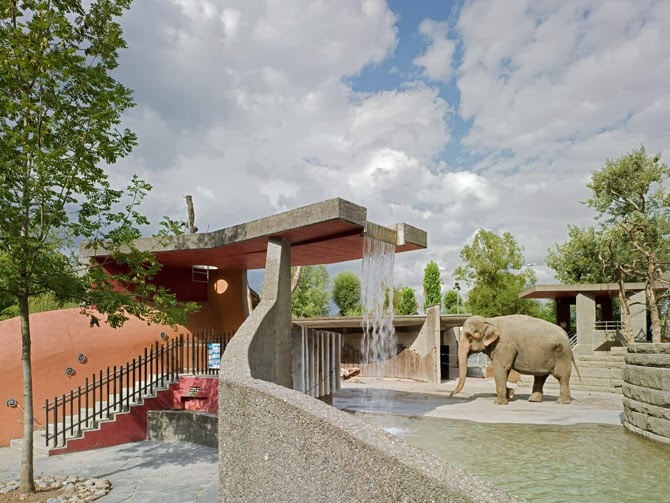
Elephant Enclosure--Knie's Kinderzoo
Thursday, December 19, 2013
Vintage Knie Paper
1946 designer Hans Falk Voitech Trubka
1950 designer Fauquex Who is this?
1960 designer Marcus Campbell Is this Gilbert Houck?
1975 designer Donald Brun Is this Louis Knie?
1977 poster designer T.Steinemann & R.Jung
Wednesday, December 18, 2013
Carmon Department of Agriculture Yearbook 1904
The First Sire Selected For Use In The Experiment Of The Department Of Agriculture To Develop An American Breed Of Carriage Horses.
Buck The World's Greatest Educated Horse
The World’s Greatest Educated Horse Buck, owned by Hardy Murphy of Ardmore, Okla., at the Fort Worth, Texas Stock Show. Year Unknown
Tuesday, December 17, 2013
Little Ruth 1893
Interesting thing about this wonderful old cabinet card is the genetic phenomena, rivaling in my mind an immaculate conception, the birth of a litter of 5 foals of which Little Ruth was apparently the sole survivor. Before the world became more educated the liberties taken with show business advertizing was indeed spectacular, stupendous, the best and only one, there is no other, first time only, etc. etc.
Sunday, December 8, 2013
For Paul
It was spring of 1975 on the Great London Circus. One of the tigers had a litter and the mother would not take care of the 6 cubs. I knew how….and became their surragate mother. The little one that I am holding was given to me as payment for caring for the litter. They all lived. There is more to this story which I will relay to you in person if you have any interest.
http://www.thecircusblog.com/.
Wednesday, December 4, 2013
John Robinson--Harry Philadelphia
Note the beautiful twisted willow whip. Becoming as rare as the Hope diamond......................
Business Card
Noting the whip, Mr. Philadelphia must have also presented a liberty act. Why have we never heard much spoken about Harry Philadelphia? Does anyone have any insight into the man?
Theodor Schröder--Hagenbeck Wallace
"Here's a picture of Mike and Ike, two of giant
polar bears with John Robinson's Circus, coming to Pittsburgh for
afternoon and night performances on Monday and Tuesday, May 4 and 5.
Mike and Ike are two of the best performers in Theodor Schroder's group
of Siberian polars, said to be the best bear act ever presented to the
public."
Business Card
Sunday, December 1, 2013
Another Mystery Solved
Swedish Museum of Natural History
NATURE International Weekly Journal of Science
Nov. 6, 2013
A 300-year-old pickled fetus that was classified by Carl Linnaeus as the type specimen of the Asian elephant has been proved to be an African elephant — by the use of the emerging technology of ancient proteomics.
Evolutionary geneticist Tom Gilbert, whose University of Copenhagen lab owns one of the world’s most advanced DNA sequencing machines, had failed to identify the species from a DNA sample seven years ago because it was too degraded. To sidestep this problem, he and his colleague Enrico Cappellini decided to run an advanced protein analysis using a sample from the oesophagus of the fetus, held in the National Museum of Natural History in Stockholm. “Clearly it’s got protein, because the damn thing still exists,” Gilbert says.
The team sequenced several proteins in the specimen that were known to vary between elephant species, and each pointed to an African origin for the fetus (see go.nature.com/ivzyzm). Linnaeus assigned the elephant fetus as the type specimen of the Asian elephant (Elephas maximus), but zoologists had long suspected that it was in fact an African elephant (now called Loxodonta africana).
The work demonstrates the power of studying ancient proteins. Proteins are more resistant to degradation than DNA and could push the molecular fossil record back millions of years, as well as revealing biological insights that cannot be gleaned from genetic material alone, say scientists who study such remains.
Ancient protein analysis is not a new pursuit, says Matthew Collins, a biogeochemist at the University of York, UK. As long ago as 1954, amino acids were detected in trilobite and dinosaur fossils.
But the field took off in 2000, when Peggy Ostrom, a geochemist at Michigan State University in East Lansing, reported protein sequences from ancient bison and walrus bones up to 50,000 years old. Her lab was the first to analyse ancient proteins using the technique of mass spectrometry, which ionizes peptide fragments and then measures their mass, enabling identification when compared with reference databases. Mass spectrometry revolutionized the field of proteomics, in which hundreds of proteins from a tissue are analysed at once, and made it possible to sequence fragmented ancient proteins.
Early efforts by Ostrom, Collins and others focused on individual proteins that are abundant in bone remains, such as collagen. “We call it the barcode of death,” says Collins, who uses collagen sequencing to quickly and cheaply identify species found at archaeological sites, such as the animals used to make parchment or the horns on Viking helmets. Collagen is also remarkably stable: it has been sequenced from a 3.5-million-year-old fossil of a giant camel from the Arctic.
But collagen differs very little between closely related animal species, making it useless as a marker for evolutionary change. “You cannot tell an ibex from a domestic goat; you cannot tell a human from a Neanderthal,” Collins says. So Cappellini began developing methods to identify large numbers of different proteins in long-dead organisms. In 2012, his team identified 126 proteins from a 43,000-year-old woolly mammoth femur. Earlier this year they sequenced 73 proteins from a 750,000-year-old horse fossil. Both specimens also yielded DNA, but the protein data could reveal the additional information about which genes were expressed in bone tissue.
Like DNA sequencing, however, mass spectrometry of an ancient sample can yield an overwhelming amount of data, says Ostrom. “It can be daunting, you can get hundreds of sequences from just a single sample of a single protein, from one individual,” she says. And, like ancient DNA, ancient proteins suffer from contamination and chemical modification, although less is known about those processes with proteins, Ostrom says. Another drawback is that proteomics relies on databases of protein sequences to identify the proteins found. Such databases are lacking for most modern animals, let alone their ancient ancestors.
Researchers studying ancient proteins hope to do more than just sort out museum collections, although Gilbert and Cappellini are working on plenty of these. Ancient proteins can indicate which genes were active in particular tissues from old specimens. They can also reveal phylogenetic information from specimens in which the DNA is too degraded to analyse, such as ancient samples from warm climates, where DNA doesn’t last long, says Collins.
For instance, the evolutionary relationship between humans and Homo floresiensis, a short-statured human fossil from the Indonesian island of Flores, is unclear, and efforts to extract DNA have so far failed. Ancient proteins might finally place this ‘hobbit’ correctly on the human family tree.
Thursday, November 28, 2013
Saturday, November 23, 2013
War Elephant Revisited
The war elephant allowed royalty and generals to engage in battle with
each other in Homeric fashion. The classic arrangement as described in
Thai military manuals was to have the high-status warrior sit in the
front where we would normally expect the mahout or elephant driver to
be. He would be helped by two soldiers who could be found further
back on the elephant. One would sit on a raised dais that functioned as
an open howdah where an assortment of pole weapons
were kept; the other would be the mahout who directed the elephant's
movements from the rear. The difference between this classic arrangement
with a 3-man crew and the four-man crew shown in the 1866 photograph in the "Lincoln letter" blog post may be the addition of a hand-gunner (possibly the second man from
the right in the photo).
War Elephant Revisited
In Thai warfare, the elephant's greatest use was that of a war mount, for kings and commanders of armies. When employed in battle, the war elephant carried three persons on his back. The king or commander, who sat alone on the elephant's neck in order to fight the enemy commander in direct mortal combat. This was a little like the individual contests between warriors in the "Heroic Age" of Ancient Greece or the jousts between knights in armour in Medieval Europe.
The tactical commander sat in the middle of the seat, strapped to the animal's back, handling either two flags or peacocks tails to signal directions of movement to the soldiers below. A third soldier sat on the elephant's hind quarters, in order to drive the animal and take care of the weapons attached to the middle seat.
The war elephant was surrounded at all times by a bodyguard of up to eight foot soldiers, known as "Chaturonkbath". It was their duty to protect the elephant's legs from a surprise attack or other cowardly maneuver by a dishonorable enemy.
The sight of the king or commander of the armies, seated on the back of the elephant and overlooking the battlefield, must have been truly magnificent and a great inspiration to his soldiers. But he would also have been highly conspicuous and vulnerable to enemy projectile weapons.
This vulnerability and indeed the role of the elephant on the battlefield began to be questioned in the seventeenth century, when large numbers of Europeans began to arrive in South East Asia. The reason for this questioning was because these Europeans brought with them, new and terrifying weapons, efficient hand held firearms.
The most notable of these weapons was the musket. It was a deadly weapon, which could kill a king, a commander or indeed an elephant at a distance. It did, however, have two major failings, which to some extent mitigated its effectiveness. It had a slow rate of fire, approximately one shot per minute, and it was inaccurate over a distance of more than two hundred yards.
European armies had developed tactics to overcome the musket's shortcomings and these could be adapted to take account of the elephant's traditional role on Thai battlefields. By the mid‑nineteenth century, however, the accurate and fast firing, repeating rifle had replaced the musket.
This development not only changed the battlefield, but it made the lung or commander and also the elephant too exposed to distant attack. So the elephant was quietly retired from the battlefield. He did, however, continue to do valuable service for the army in a support role, even as recently as the Second World War, and he proved to be an inspiring sight in parades and at ceremonial functions.
War Elephant Revisited
Siamese war elephant, 1866 without armor
To the King of Siam
February 3, 1862
Abraham Lincoln,
President of the United States of America.
To His Majesty Somdetch Phra Paramendr Maha Mongut,
King of Siam,
Great and Good Friend: I have received Your Majesty's two letters of the date of February 14th., 1861.
I have also received in good condition the royal gifts which accompanied those letters,---namely, a sword of costly materials and exquisite workmanship; a photographic likeness of Your Majesty and of Your Majesty's beloved daughter; and also two elephants' tusks of length and magnitude such as indicate that they could have belonged only to an animal which was a native of Siam.
Your Majesty's letters show an understanding that our laws forbid the President from receiving these rich presents as personal treasures. They are therefore accepted in accordance with Your Majesty's desire as tokens of your good will and friendship for the American People. Congress being now in session at this capital, I have had great pleasure in making known to them this manifestation of Your Majesty's munificence and kind consideration.
Under their directions the gifts will be placed among the archives of the Government, where they will remain perpetually as tokens of mutual esteem and pacific dispositions more honorable to both nations than any trophies of conquest could be.
I appreciate most highly Your Majesty's tender of good offices in forwarding to this Government a stock from which a supply of elephants might be raised on our own soil. This Government would not hesitate to avail itself of so generous an offer if the object were one which could be made practically useful in the present condition of the United States.
Our political jurisdiction, however, does not reach a latitude so low as to favor the multiplication of the elephant, and steam on land, as well as on water, has been our best and most efficient agent of transportation in internal commerce.
I shall have occasion at no distant day to transmit to Your Majesty some token of indication of the high sense which this Government entertains of Your Majesty's friendship.
Meantime, wishing for Your Majesty a long and happy life, and for the generous and emulous People of Siam the highest possible prosperity, I commend both to the blessing of Almighty God.
Your Good Friend, ABRAHAM LINCOLN.
Washington, February 3, 1862.
By the President:
WILLIAM H. SEWARD, Secretary of State.
Annotation
Thursday, November 21, 2013
Who Was First?
1796: A Beer-Drinking Elephant Comes to New Yorkby P. Gavan |
Elephant
is the first ever to come to America On April 3, 1793, John Bill
Ricketts, an English equestrian rider, introduced America to the circus
in Philadelphia. Ricketts’ circus featured horses, acrobats, a rope
walker, and a clown -- but it didn’t have an elephant. As of that date,
no elephant had ever stepped foot […]
http://www.naturalhistorymag.com/editors_pick/1928_05-06_pick.html
HISTORY BUFF.COM
Captain Jacob Crowninshield arrived in New York
on April 12, 1796 with a two year-old elephant. Upon speculation, he had
purchased the pachyderm in India and brought it to America. The entire
venture cost him $450.
The elephant was
exhibited in New York at the corner of Beaver Street and Broadway on
April 23, 1796. At that exhibition, a Welshman named Owen offered to buy
it for $10,000. From there, it seems the elephant went of tour
constantly for many years.
It is
advertised in the Aurora of August 12, 1796 as being on the way to
Charleston and Baltimore. It could be seen on High Street for 50¢. On
November 7, 1796 we now find the elephant on exhibit in Philadelphia on
Market Street "from eight in the morning until sundown", but this time
only 25 cents admission. The pachyderm stayed on exhibition in
Philadelphia throughout the winter. An article in the Boston Gazette of April 25, 1797 states that "he has grown considerably since her arrival" last year. The Columbian Centinel
of Boston announced in its July 26, 1797 edition that "The elephant is
just arrived in town and may be seen at Mr. Valentine's, Market
Square... The greatest natural curiosity ever presented to the public.
He so far surpassed all description that has ever been given him that we
shall not attempt it here. Admittance half a dollar."
By
reading an article in the same paper a few days later, it is apparent
that not many people were willing to pay 50 cents to see the elephant.
The article states "By the desire of the proprietor in Philadelphia, the
elephant is now to be seen for a quarter of a dollar." Lowering the
price must have worked, as the pachyderm stayed there on exhibition for
almost a full month.
From there, through
newspaper accounts and advertisements, we can learn that the elephant
for the next dozen years was almost constantly on tour throughout New
England, Pennsylvania and the Carolinas'. The last recorded exhibition
of the elephant is an account of its exhibition in York, Pennsylvania on
July 25 and 25, 1818. The pachyderm never was given a name and
constantly referred to as "the elephant" or "he". (As a side note, as
evidenced by an entry in a Reverend's diary, who had seen the animal,
"he" was actually a "she.")
Old Bet was the second elephant, imported into
Boston by Edward Savage in 1804, and acquired by Hachaliah Bailey of
Somers within the following few years. A document in the Somers
Historical Society shows that by 1808 Hachaliah Bailey was selling off
shares in his elephant to two other partners for $1200 each. Old Bet
was killed in Maine in 1816, and her skelton and hide were exhibited in
New York the following year.
The third elephant, Little Bet, also owned by
Hachaliah Bailey and imported in 1817, was killed in Chepachet, Rhode
Island by a group of men. Hachaliah also imported Columbus the elephant
in 1817. In 1825 his three story brick "Elephant Hotel" was completed
in Somers New York, with a granite pillar supporting a statue of an
elephant. Today the building houses the Town Hall and a museum about
the Early American Circus. The Elephant Hotel was awarded National
Historic Landmark Status in April of 2005.
Needing a rest, Bailey later leased the animal to Nathan Howes. Both
became wealthy from the venture and their success was the imputes to
become circus showmen -- The Great Howe Circus and the Barnum and Bailey
Circus.
Old Bet was moved from town to
town on foot by night -- so curiosity seekers could not see her for free
-- and displayed in tavern yards and barns during the day.
Unfortunately, while in Maine, Old Bet was killed. Some staunch
supporters of the Blue Laws (sinful to be entertained on a Sunday)
decided to end the matter once and for all. As the elephant was being
led into town just before daylight, on July 26, 1816, the group waylaid
the party and fired a half dozen shots that killed her.
Old Bets' death did not stop her from going on
exhibition. A mere 9 months later, advertisements started appearing in
New York newspapers that relate that the owners had the remains of Old
Bet stuffed and preserved. For the next four years, Old Bets' remains
toured New England. In 1821, the American Museum in New York announced
that they had bought Old Bet and she would now be on permanent display
at the museum.
According to the Massachusetts Spy of July
15, 1818, another elephant was brought to America and was named
Columbus. This pachyderm was on constant display until 1847.
Up
until this point, none of the elephants that had been on display in
America could not do tricks to entertain or amuse their viewers. This
changed in September, 1821. The Learned Elephant, Little Bet went on
tour and could perform many tricks. Among them, kneel, balance her body
alternately on each pair of legs, present her right foot to permit her
keeper or any other person to mount her trunk, carry them about the room
and safely return them, draw a cork from a filled bottle and drink the
contents and then present the empty bottle and cork to the keeper. She
could lie down, sit up and rise at command, bow and whistle on request,
and answer to the call of her keeper.
While
Old Bet was intelligent, its owner made a dumb mistake in the manner
that he promoted her. As part of the publicity, the owner was constantly
reminding the crowd that Little Bet's hide was so tough and thick that
even a bullet couldn't penetrate it. Under the category of "boys will be
boys", five youths decided to test it out. On July 31, 1822, after a
performance, they fired at her from behind an Elm tree, the bullet
struck her in the eye and she fell dead in her tracks. In doing so, the
owner was proved a liar, but at the expense of losing the first well
trained pachyderm in America.
By 1824
elephants were no longer being displayed as a single-attraction. Rather,
menageries emerged in a great scale with many having dozens of
different animals, including an elephant, on display under one roof. It
wasn't until 1882 that another elephant in America would become famous
as a single attraction.
In 1882, P.T.
Barnum offered the London Zoo $10,000 to buy their elephant named Jumbo.
The elephant was the largest in the world and measured 10 feet 10
inches tall, weighed 8 tons, and had a trunk 27 and a half inches in
circumference.
Jumbo was first shown at
Barnums' Hippodrome that same year. The animal traveled in an especially
designed palace car. Millions of people paid to see Jumbo. On September
15, 1885, while on a layover in St. Thomas, Ontario, Canada, Jumbo was
standing on the train track when a train rushed upon him. Jumbo was
caught between the line of circus cars and the oncoming train and
killed. His hide was preserved and later given to Tufts College, while
the skeleton was given to the Museum of Natural History.
Jumbo
was loved by so many people that, after his death, people automatically
began referring to anything larger than normal as being "jumbo-sized."
To this day, over a hundred years later, the term has stayed a part of
the English language.
Subscribe to:
Posts (Atom)